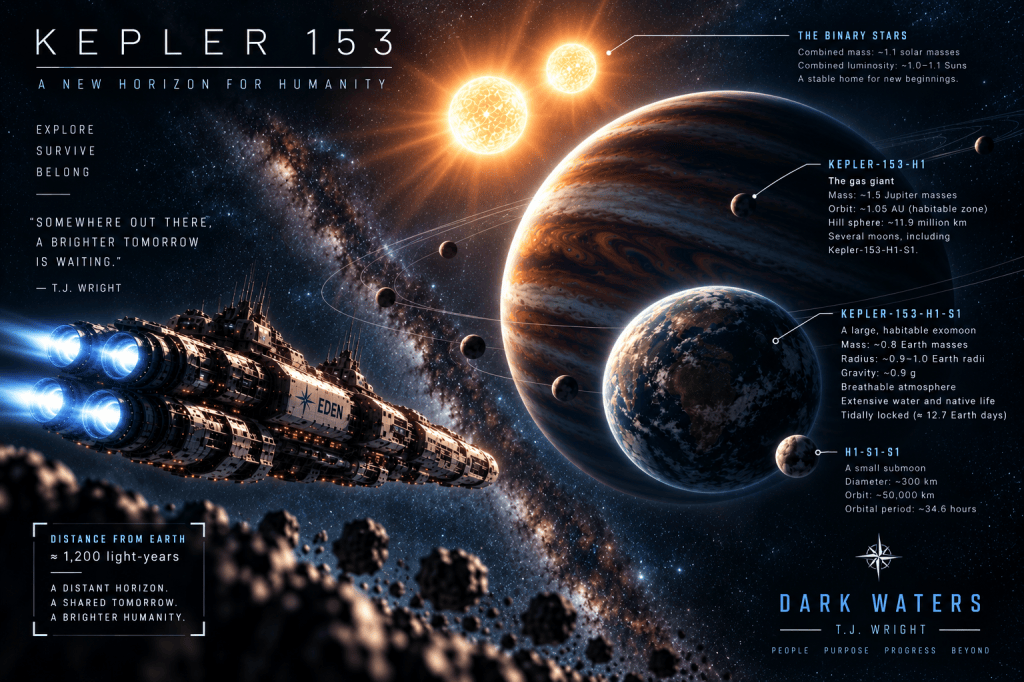
From roughly 1,200 light-years away, Kepler 153 is little more than light, gravity, mathematics, and inference.
Humanity has never been there.
No human being has stood beneath its twin suns.
But Kepler 153 is not unknown.
Decades of increasingly sophisticated observation have mapped the system from afar. Scientists have imaged its worlds, studied their atmospheres, measured their orbits, analyzed surface composition, and built detailed models of the planets and moons surrounding the binary stars.
The problem is distance.
At 1,200 light-years away, even the best scans leave gaps. Resolution has limits. Atmospheric readings are incomplete. Surface features blur together. Biological signatures can suggest life without explaining what that life actually is.
Humanity knows enough to believe Kepler-153-H1-S1 may be habitable.
It does not know enough to understand the world waiting there.
Kepler 153 is a binary-star system, two stars orbiting a common center of gravity while an increasingly complex family of worlds circles them both. Together, the stars produce roughly the luminosity of our own Sun—enough to create a broad region where liquid water could theoretically exist. Kepler 153 System
For centuries, only the largest disturbances in the system could be detected.
Then the instruments got better.
Long-baseline observatories became more precise. Spectroscopy improved. Gravitational modeling sharpened. Tiny changes in stellar light and planetary motion began revealing worlds that previous generations had never known were there.
And Kepler 153 became crowded.
The designation H tells part of that story.
By the time modern surveys finished revising the system, several planetary bodies had already been identified inward of the region humanity was most interested in. What had once appeared relatively simple became a surprisingly populated planetary system.
Then astronomers found Kepler-153-H1.
A gas giant approximately one and a half times the mass of Jupiter, orbiting roughly one astronomical unit from the system’s binary stars—inside the region where temperatures could permit water. Kepler 153 System
A gas giant in the habitable zone was interesting.
Its moons were far more interesting.
One of them became Kepler-153-H1-S1.
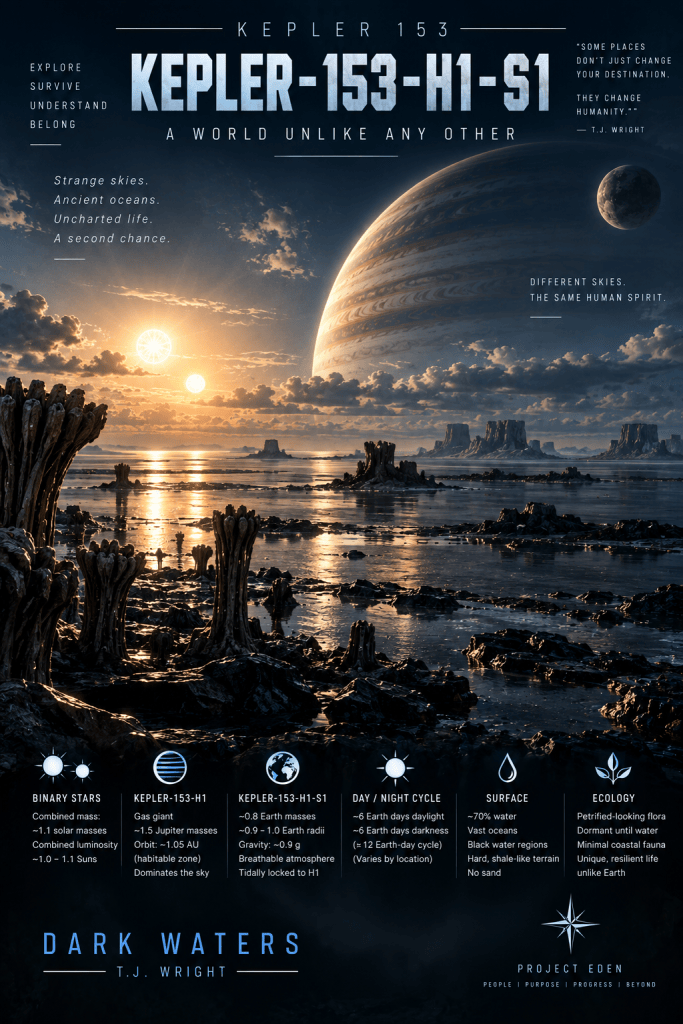
Models suggest a world slightly smaller than Earth, with gravity close enough to our own to be comfortable for humans. Atmospheric spectroscopy indicates what researchers believe may be a breathable atmosphere. Observations suggest enormous quantities of liquid surface water and strong chemical signatures consistent with a living biosphere. Kepler 153 System
It is not Earth.
Its sky would be dominated by the enormous gas giant it orbits.
Because the moon appears tidally locked to H1, that planet would remain almost fixed in the sky from one hemisphere—and would never be seen at all from the other. Kepler 153 System
Its rotation is equally alien.
One cycle around the gas giant takes approximately 12.7 Earth days, producing stretches of daylight and darkness lasting roughly six Earth days each. Kepler 153 System Kepler 153 System
And orbiting even that world appears to be something smaller still:
A tiny submoon, only a few hundred kilometers across, racing around H1-S1 in roughly thirty-five hours. Kepler 153 System
From Earth, Kepler-153-H1-S1 appears extraordinary.
Water.
Atmosphere.
Temperatures capable of supporting life.
Perhaps even an ecosystem waiting beneath alien skies.
But astronomy has limits.
Scientists can measure light.
They can measure mass.
They can study atmospheric chemistry from across the void and build increasingly sophisticated models of a world humanity has never touched.
But eventually there is only one way to learn whether those models are right.
You have to go there.
And aboard the ESV Eden, more than two thousand people are about to do exactly that.
Tomorrow, humanity leaves Earth behind.
DARK WATERS
A Kepler 153 Novel
October 1
#DarkWaters #Kepler153 #ScienceFiction #SciFi #SciFiHorror #SpaceExploration #FirstContact #IndieAuthor #TJWright


Leave a Reply